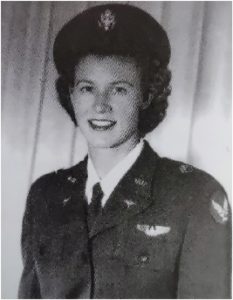

 Elizabeth I. White Dybbro
January 17, 1922- January 21, 2025
Class: 44-W-6
Training Location: Avenger Field (Sweetwater, Tex.)
Assigned Bases: Marfa Army Air Base (Tex.) and Las Vegas Army Air Field (Nev.)
Planes flown: PT-17, BT-13, AT-6, UC-78, AT-10, B-17, B-26, P-39
“I thought instead of just riding in an airplane, I’d fly it.”
Elizabeth ‘Betty’ White’s interest in flying began in 1934 when a family member paid for her to take a plane ride at Smith Field in Fort Wayne, Indiana. White was 12 years old. Aviation was in its infancy and White’s interest was piqued. “Amelia Earhart was my hero,” she said.
Her interest in soaring through the skies was renewed in 1942 when she read a magazine article about a new program in the military that needed women as pilots. The article explained that female pilots were being recruited to help the war effort on the home front. The women would be called WASP (Women’s Air Service Pilots). They could ferry aircraft, test planes, instruct male pilots, and tow targets for anti-aircraft artillery practice.
Applicants were required to have 35 hours of flight time. White paid for lessons at Smith Field at a cost of $10 per hour. It was an exorbitant amount for a young, single working woman on a budget. White submitted her application and was accepted. She was one of 1,830 applicants among 25,000+ applicants selected to train and serve as Army pilots.
At Sweetwater, Texas, where WASP training was held, White and the other women received training equivalent to that given to male pilots, including college-level courses in math, physics, Morse code and navigation.
The women learned how to navigate solely by instruments. They had to complete a 2,000-mile solo flight before earning their wings.
When White had her wings pinned on her in August 1944, she was one of 1,074 women who would complete the WASP program. One memorable mission saw her obeying a base commander’s unusual orders to fly her AT-6 low over the desert, simulating real combat conditions for ground gunners. Flying so close to the ground, her daring maneuver startled the men, who fled, convinced she would crash. Though she was reprimanded for her boldness, the moment perfectly captured her courage and skill.
By December 1944 the war in Europe was turning in favor of the Allies. Male pilots, needing a rest from combat, were sent back to the States. The WASP program was abruptly canceled so the men could take the positions held by the women.
After the WASP program disbanded, Elizabeth continued to break barriers, becoming one of the few female flight instructors of her time.
Sources:
Texas Women’s University in Denton, Texas, WASP Collection
Vintage Eats of Kayleen Reusser, her book “We Gave Our Best: American WWII Veterans Tell Their Stories” contains the story of WASP Betty White Dybbro.