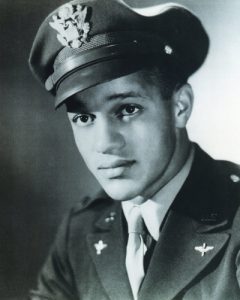
Leslie A. Williams
1919-2015
Class: 43-J-SE
Graduation date: 11/3/1943
Rank at time of graduation: 2nd Lt.
Service # 0814824
From: San Mateo, CA
“We told each other, ‘We’re going to be the best. We stuck with that, and we helped each other.’”
Unlike many of his peers, Leslie Alan Williams had not dreamed of becoming a pilot before faced with the World War II draft and the option of flight school. Williams was a budding tap dancer, and he dreamed of following his hero Bill “Bojangles” Robinson on the stage.
“I wanted to serve. I was very patriotic,” he told Stanford Lawyer in 2008. “And I didn’t want to get drafted because I thought that as a Black man I’d be drafted as an infantryman. And I’d seen so many infantrymen after World War I with amputated limbs. Dancing was my life. I thought—I’d rather crash and die than wind up unable to dance. So, I set my sights on flying.”
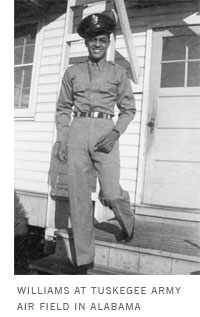
Williams was drafted into the Army in 1939. After training for nine months at Tuskegee Army Airfield in Alabama, he earned his wings in 1943, at a point when the American military was racially segregated. “In those days, no one had to salute blacks, but we could be court-martialed if we didn’t salute a white officer.” By the time the all African-American cockpit crew had been trained and was ready for combat, the war was over.
Because he was educated, Williams’ white commanding officer asked him to lead the unit while the officer went on his honeymoon. Williams, sensing his advantage, insisted on being made a master sergeant. “The highest sergeant that you’ve got,” Williams stipulated. “Three stripes down and three stripes up.”
A providential encounter
 Williams then mustered up a unit band, playing venues including christening parties at the nearby Kaiser shipyard. At one such fete, he said, a general approached the bandstand.
“We all popped to attention and he said, ‘Relax, I want to tell you that you boys are very good. I like your music, and I like the way you present yourselves, and I want to do something for you. What do you want to be in the Army?’ I said, ‘I want to be a pilot.’ This was about midnight. He told me to go into downtown Seattle tomorrow ‘and tell them I sent you.’ I get down there at 8 the next morning and they’d already gotten their orders … to pass me through.”
Williams was sent to Tuskegee Institute (now University), where he became one of 996 African-American World War II pilots known as the Tuskegee Airmen. These pilots gained fame escorting bombing missions over Europe and North Africa, protecting U.S. bombers from German attacks. They were also navigators, engineers, bombardiers and, like Williams, bomber pilots. Initial flight training came from the nation’s very few Black civilian instructors, including Les’ cousin Archie, ’35, who had learned to fly at UC Berkeley.
‘Feeding the buzzards’
“They weren’t prejudiced, of course, but they were very strict,” Williams told aviation journalist Evan Isenstein-Brand in 2008. “A lot of the guys with me had already flown. I had not. I hadn’t even seen an airplane close up at all. And so I said, ‘I’m not going to make it. These guys know what they’re doing.’ So, I go up for the first time in this open-cockpit plane (a PT-13 Stearman) and I was shaking all over.
“One of the things that was very embarrassing, especially for the elite guys, was getting airsick over the side and it splattered against the fuselage. We called it ‘feeding the buzzards.’ I didn’t. I loved it! I thought, ‘Maybe I’m on equal footing here, after all.’
After that initial training, Williams said, cadets reported to the Army air base at Tuskegee, “and that’s when the trouble started.”
“You see, at Tuskegee University, we didn’t feel like we were too much in the Army. There were girls there and we had Black instructors. But when we got to the Army field there was nothing but white officers and most of them were from the South and they were very mean. I’m sure you know what the ‘N’ word is. Well, that became my name for another seven months … and it was humiliating and disgraceful.
Under this duress, Williams said, “we all helped each other out. If one of our brother pilots was having a problem, we’d find somebody to help them. We’d stay up all night sometimes to help someone pass. … There were classes before me where out of 45 students, only three would pass. Out of the 43 guys in my class, 29 graduated.”
The Freeman Field Mutiny
White superiors told enlisted men that they did not have to salute Williams and other Black officers, a breach of military discipline. Williams narrowly escaped arrest in April 1945 when he and other officers in the all-Black 477th Bombardment Group sought to drink in the all-white officers’ club at Indiana’s Freeman Army Air Field, an event that became known as the Freeman Field Mutiny. To remain pilots, the African-American officers had to sign a document acknowledging a hastily drafted regulation affirming the club’s segregation.
Williams would have gone to Europe as a fighter pilot, but he lost consciousness twice while doing loops in aerobatic training. He thought he would have to resign his commission, but providence again stepped in. The War Department began to train Black bomber pilots in the larger, less agile twin-engine B-25. Williams “happily learned that they can’t do loops.” He became, he said, the first Tuskegee Airman rated for the B-25. Yet the war ended before Williams could fly combat missions.
He gladly left the Army in 1947 – one year before President Truman signed the order desegregating the armed forces – and assured his new wife, Elsie, that California was more welcoming than the South. Driving west, however, Williams was almost lynched near the California state line for ordering takeout – in uniform – at a whites-only diner. Violence was averted, he said, only when the instigator realized that he was a pilot.
Williams attended Stanford on the GI Bill, graduating in history in 1949. He recalled being one of only two Black undergraduates. When he returned for law school at the age of 52, he said, his law class of ’74 included a handful of African-Americans. After a long day in law school, Williams taught evening dance classes at his studio on San Mateo Drive. The studio itself was an uphill battle, he said: After the City Council approved his permit on a 3-2 vote, a woman threw her purse at him in rage. But other San Mateans sent him unsolicited checks and good wishes, and many locals enrolled their kids in his classes “just to see you do well.”
In 2007, President George W. Bush awarded Williams and his fellow Airmen the Congressional Gold Medal for their “unique military record that inspired revolutionary reform in the Armed Forces.”
“Bush apologized for how we had been treated. In fact, he saluted us all,” Williams said.
“We weren’t vindicated, because there can be no such thing. But we were recognized, and told of the respect there should have been.”
Sources:
Photo courtesy U.S. Air Force Historical Research Agency, Maxwell AFB, Alabama
Stanford Magazine
College of San Mateo