
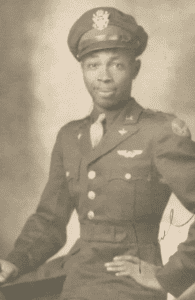
 Major Jewel Barton Butler, Sr.
June 6, 1922 – December 13, 1992
Class: 46-A-SE
Service # 02078770
Graduation date: 3/23/1946
Jewell B. Butler began his military career, at Tuskegee Army Air Field as an Aviation Cadet where he would fly the PT-17, BT-13, AT-6 prior to his graduation and the P-40 in transition training before being assigned to the 99th Fighter Squadron, 477th Composite Group at Lockbourne Army Air Base where he would fly the P-47D and P-47N Thunderbolt.
Colonel Benjamin O. Davis Jr. assumed command of the 477th Bombardment Group at Godman Field, Kentucky on June 21, 1945 which consisted of B-25 medium bombers and four medium bombardment squadrons. He immediately initiated reorganization plans to conform with directives as set down by the War Department.
With the anticipated return of the 332nd Fighter Group to the United States for redeployment, the War Department saw fit to merge the two units. Two of the four Medium Bombardment Squadrons were inactivated in June 1945 and the 99th Fighter Squadron was reassigned, re-designated 99th Fighter-Bomber Squadron and equipped with P-47 Thunderbolts thus forming a Composite Group of Fighter-Bombers and Medium Bombers.
This transition period brought about a lull in the training program until an administrative change was made. All of the white personnel were transferred and key, Combat experienced Negro Officers joined the unit daily to take over some of the vacancies.
The Bombers had practically completed all phases of training for overseas movement but the Fighter-Bomber squadron had to be organized and trained for overseas movement to the Pacific Theatre. Many combat returnee veterans of the 332nd Fighter Group joined the 477th Composite Group to form the nuclei of the Fighter Squadron. Steady progress in training was made up to V-J Day to prepare the Group for combat operations in the Pacific Theater with a deadline of October 1, 1945.
After V-J Day the mission of the 477th Composite Group was primarily to facilitate the discharge of all eligible personnel, and to continue training on a peace time basis, and reorganize the post-war element of Negroes in the Army Air Forces. On October 8, 1945 a third Bombardment Squadron was inactivated.
2nd Lt. Jewell Butler joined the 99th Fighter-Bomber Squadron in April 1946. On August 15, 1946 2nd Lt. Butler was Number 2 of a four-ship formation flight of P-47’s with Lt. Lincoln W. Nelson as the flight leader, number three 2nd Lt. Ernest Davis and number four Major William A. Campbell.
After completing the landing roll and turning off the runway it was noticed that the No. 2 ship had a prolonged fire in the supercharger section after the landing roll. Lt. Butler apparently retarded his throttle too much causing the engine to “load up” and catch fire in the supercharger flight hood. When notified over the radio by his flight leader of the fire in his supercharger he ran up his engine to blow the fire out and excitedly applied his brakes; the combined factors of sudden increased thrust and halted forward motion caused aircraft to nose up, striking its prop and falling back on its tail. 2nd Lt. Butler cut the switches and exited the ship without any injuries.
During the Korean Conflict 1st Lt. Butler was assigned to the 3rd BG where he flew the B-26 Invader on daylight and night intruder bombing mission, to include many low-level machine-gun strafing attacks into North Korea. He was awarded the Air Medal with Two Oak Leaf Clusters by Headquarters Fifth Air Force for his service during the Korean Conflict.
Visit the Red Tail Virtual Museum to see a mural honoring Butler painted along wall on a downtown Denison, Texas business.
Source: Craig Huntly, Tuskegee Airman Subject Matter Expert